
Physical AI Data Operations
Physical AI Data Operations
Training data for robotics VLA and autonomous systems
Volo NXT works with partner to help AI teams turn real-world recordings and sensor data into structured training and evaluation datasets. We combine North American client engagement with specialist delivery operations in India, supporting data collection, annotation and quality review as your program grows.
Encord workflow experience

For teams using Encord, we bring access to partner annotators familiar with Encord workflows and the operational support needed to execute complex data tasks. Delivery is aligned to your project guidelines, workspace configuration and output requirements.
Encord supports annotation across video, images, LiDAR, audio and text, including sensor-fusion workflows. Its curation and review capabilities provide an environment for managing multimodal datasets. Partner supplies the human annotation and quality operations layer within the agreed customer environment.
An assessed talent base with delivery support
400+ Encord-assessed annotators: Partner’s assessed talent base provides familiarity with Encord workflows and a starting point for project-specific onboarding.
900+ annotation resources: A broader partner resource pool supports delivery planning, with quality assurance and project management alongside annotation.
Teams are selected and trained against your task complexity and quality benchmarks. Mobilization and phased ramp-up are agreed around the project scope, resource availability and pilot results.
Support across the AI data lifecycle
We support two complementary needs: perception data that helps a machine understand its surroundings, and human demonstration data that helps it learn actions and tasks. Work can begin with raw footage, an existing dataset or a defined annotation backlog, with delivery extending into ongoing quality and evaluation support.
AI Data Factory
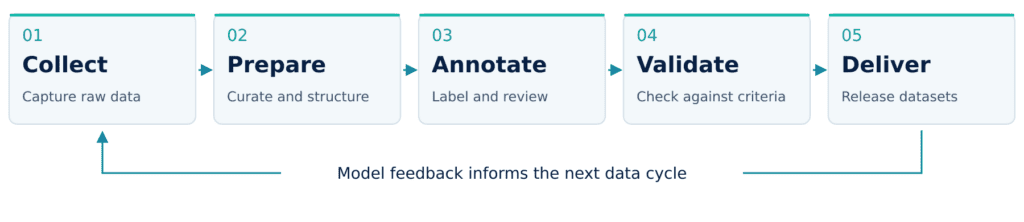
The data operation runs as a continuous cycle. Collection feeds preparation and annotation; validation determines what is ready to deliver. Findings from model evaluation then guide the next round of collection, labeling and review.
01 Collect
Capture the raw data required by your program, including first-person video, human demonstrations and other agreed image, audio or sensor inputs. Collection operations can include participant sourcing, device coordination, capture instructions and consent management, with coverage defined for the intended tasks and environments.
02 Prepare
Ingest and organize the material before labeling starts. Screen recording quality, remove irrelevant footage and segment video into useful task sequences. Establish the taxonomy, annotation guidelines and output schema with your team so the data is consistent from the first batch.
03 Annotate
Apply structured labels at frame, object or task level. Specialist teams handle perception labels, action descriptions and temporal events, using AI-assisted pre-labeling where appropriate and human judgment for review, correction and ambiguous examples.
04 Validate
Check the results against agreed acceptance criteria using layered quality control, benchmark examples and audit sampling. Resolve inconsistencies, calibrate reviewers and return corrections to the annotation team before a batch is accepted.
05 Deliver
Release validated datasets in the agreed schema and format, including JSON, XML or CSV where required. Incorporate client feedback and model error findings into the next data cycle, with targeted re-annotation or additional collection to address identified gaps.
Quality throughout the workflow
Partner’s L1 annotation, L2 quality control and L3 assurance structure provides successive review stages. Golden-set checks and calibration sessions help maintain consistency as the team and data volumes change. Review coverage, sampling and production targets are defined for each engagement.
Physical AI capabilities
VLA and egocentric AI
Prepare first-person video for vision-language-action models through footage triage, precise trimming and activity segmentation. Annotate action sequences, object interactions and temporal events, with descriptions linked to the relevant moments in a task. Human demonstrations can be structured around task progression, successful attempts and failure cases.
Robotics and embodied AI
Support robot learning with image, video and multimodal annotation that captures interactions with the physical world. Label tasks and the objects involved, preserving the sequence and context of the demonstration. The workflow can support robotics teams developing perception and manipulation capabilities.
Autonomous driving and perception
Provide 2D and 3D annotation for perception datasets, including LiDAR cuboids, point-cloud labeling and object attributes. Track objects across frames and validate correspondence between camera views and 3D data where required. Project guidelines define object classes, occlusion rules and edge cases.
Computer vision
Create bounding boxes, polygons, segmentation masks and keypoints for image and video datasets. Support classification and tracking tasks for applications such as industrial safety, product recognition and visual inspection, with quality checks matched to each annotation type.
Data collection
Coordinate egocentric, facial and human activity capture across agreed household, commercial and industrial settings. Define participant and environmental coverage before collection begins. Screen incoming recordings for framing, lighting and task completeness so only suitable footage enters the downstream annotation workflow.
Quality and evaluation support
Review labels and model outputs against task-specific rubrics, resolve guideline ambiguities and prioritize difficult examples. Human-in-the-loop review can support error analysis, targeted annotation and dataset refinement as models encounter new scenarios. Quality measures are agreed for the task rather than applied as a single blanket accuracy promise.
Delivery experience at scale
Partner brings experience across embodied AI video operations and autonomous mobility annotation. Its public delivery record includes more than 20 million images annotated and an autonomous vehicle program processing 15 million annotation frames per year. These figures describe partner’s delivery experience; project capacity and service levels are agreed for each engagement.
Broader capabilities for enabling AI
Annotation Workbench
Combine annotation tooling, trained teams and quality governance across image, video, text, audio and 3D data. Work can run within your existing annotation environment or a scoped managed workbench, with output formats aligned to your training and evaluation pipeline.
RLHF and trust and safety
Support model alignment with preference ranking, response rating and structured human feedback. Review teams apply agreed rubrics and escalate difficult examples, with quality checks designed to keep judgments consistent across batches.
LLM and language operations
Extend multimodal programs with transcription, translation, prompt-response annotation and language data review. Partner’s language operations span 22+ Indian languages, supporting programs that require regional context and language-specific judgment.
Model evaluation and QA
Support evaluation through benchmark review, response validation, red-teaming and human analysis of model errors. Feed findings back into the data operation to prioritize missing examples, revise guidelines and prepare the next evaluation set.
Platforms our annotators have used
Partner’s annotators have experience across Encord, Labelbox, CVAT, Segments.ai, Kognic, V7 and Taskmonk. Teams adapt to customer-provided environments, with project onboarding covering tool access, annotation guidelines and quality requirements.

Volo NXT and Partner delivery
Volo NXT coordinates North American client engagement and connects your team with the relevant partner specialists. Partner leads technical scoping, project training and data operations delivery through its established operations centers in India.
Engagements can start with a representative pilot to establish quality, throughput and operational fit, then expand into a dedicated delivery team as requirements grow. The aim is to relieve the data preparation and annotation burden on your engineering team while maintaining clear acceptance standards.